
Searching Chattahoochee County Civil Dockets
Start with the right court. Superior Court keeps the major civil, domestic, equity, and land-related matters. Magistrate Court takes civil claims up to $15,000 plus certain summary matters. The county Case Search link leads to an Icon login. So anyone without credentials faces no public party-name or case-number form at all. Gather the party names, the court, a rough filing or hearing range, and the exact item you want before going further. The county calendar index can point to a Civil/Domestic PDF. Georgia Courts E-Access routes users to account-based providers instead. A party-name lookup may find the case. Yet a complaint, service return, judgment, or final decree can still require a clerk request. Treat the Case Lookup label as a description of the route. That label is not a promise of guest access.
- Classify the matter as Superior civil or domestic, Magistrate, Probate, or another named venue.
- Open the county Case Search link and note the Icon credential barrier before expecting search fields.
- Check the current county calendar index for a Civil/Domestic setting and record its judge and date.
- Use Georgia Courts E-Access and the documented provider route when an account is available.
- Call or visit the clerk at the Broad Street records office when the online route is incomplete.
- Mail a focused request or ask for the Georgia Open Records process when a specific file item is needed.
Chattahoochee County Civil PDF Limits
Start with the county calendar index. Wait, use exact href: the county calendar index lists an August 14, 2026 Civil/Domestic Calendar for Judge Martin, plus a direct file named Civil - VPE Preview814.pdf. That file did not load when opened, so its column layout stays unknown. Treat the filename as an internal label. It tells you nothing about a judgment, a case status, or any disposition on the Chattahoochee County civil docket.
The official Circuit Superior Dockets link page is the next layer. It routes you to the circuit docket-management host, where civil-domestic folders sit beside criminal ones, master calendars, and administrative PDFs. Useful, but limited. A folder of PDFs is not a searchable Chattahoochee County case register, so you still browse rather than run a true docket search by case number.
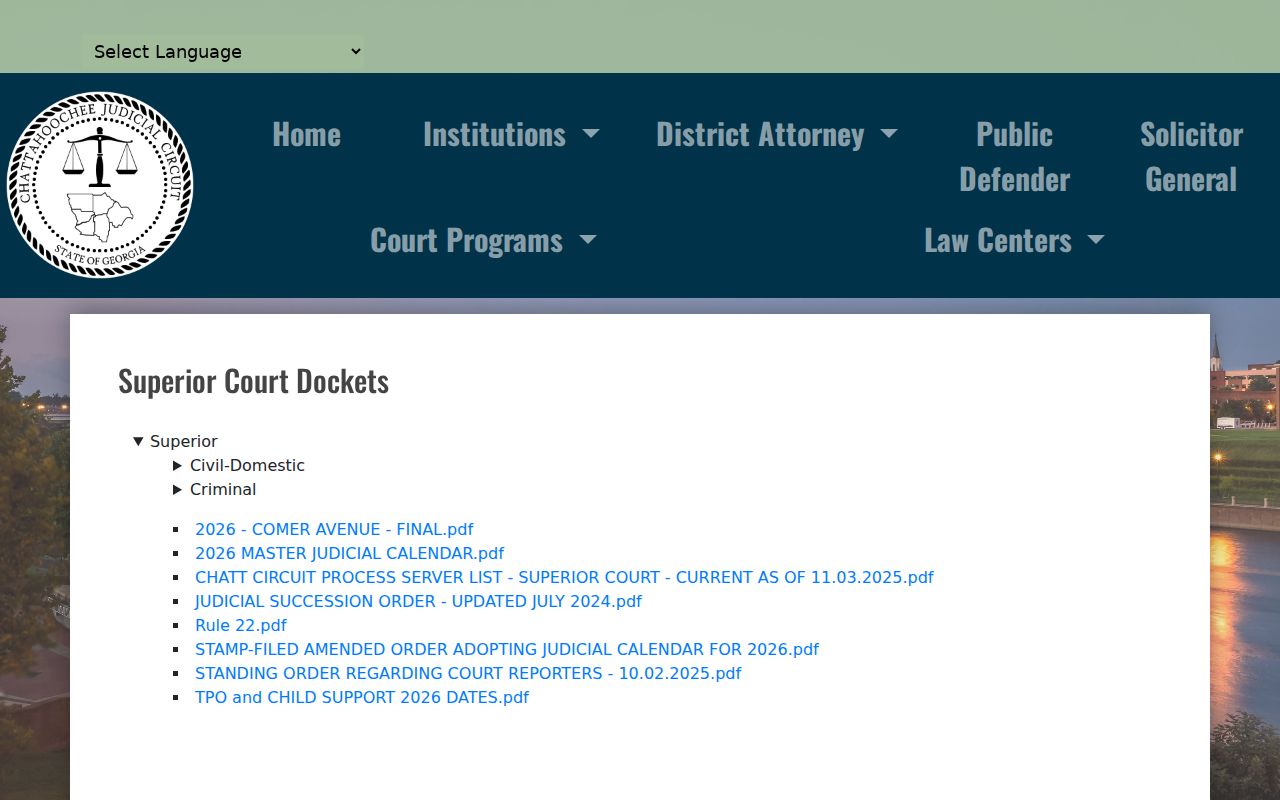
A civil calendar answers one question only: when an appearance is scheduled. For the filing history, the signed order, the disposition, or the document image behind that setting, use the clerk or an authorized record system.
Note: A public Civil/Domestic PDF can show a setting while the related register and documents remain unavailable from the unauthenticated route.
Inside a Chattahoochee County Civil Docket
Uniform Superior Court Rule 39.2 offers the best documented field model for a Chattahoochee County Superior civil docket. It lists the action number, cause of action, attorneys, parties, filing date, costs, service date and type, disposition, judge, trial and jury information, and judgment and fi. fa. entries. Cross-references to minutes, pleadings, transcripts, appeals, and remittitur round it out. The county does not publish its own civil format. Never build a case number from a year or a guessed civil code. Take the exact number from a lawful case document or from the clerk, and ask for the field or document that answers your question.
| Action number | The court's civil case identifier, used with the parties and cause of action. |
|---|---|
| Cause of action | The claim category or legal basis stated in the civil matter. |
| Parties and attorneys | Plaintiff, defendant, and counsel fields, subject to redaction of protected identifiers. |
| Filing date and costs | The filing date plus advance or additional costs recorded by the clerk. |
| Service | Date and type of service, with a return showing how process was handled. |
| Disposition | Dismissal, settlement, judgment, final divorce decree, administrative termination, transfer, or another entered result. |
| Judge and trial history | Judge, trial date, jury or mistrial information, and related setting entries. |
| Appeal cross-references | Minutes, final record, pleadings, transcripts, motions, notice of appeal, and remittitur links or references. |
A calendar appearance is not a disposition. A motion setting proves nothing about the ruling. The official result lives in the signed order or the register entry.
Chattahoochee County Civil Filing Fees
The local fee notice gives useful anchors. But its amounts describe filing and service, not the price of a docket copy. Civil, domestic, modification, and garnishment filings are listed at $213.00. Divorce filings carry the same $213.00 figure. Sheriff service is listed at $50.00. These charges explain how a case starts and how process gets served. They say nothing about what a plain, certified, transcript, or vendor copy will cost.
| Item | Amount or status | How to read it |
|---|---|---|
| Civil, domestic, modification, or garnishment filing | $213.00 | Local filing fee, not a copy fee |
| Divorce filing | $213.00 | Filing fee, not the price of a final decree copy |
| Sheriff service | $50.00 | Service fee for process, not a docket search charge |
| Plain or certified court copy | Not located | Ask the custodian for a current estimate |
| Transcript | Not located | Obtain a quote through the applicable reporter or court process |
Georgia Attorney General open-records guidance allows reasonable search, review, copy, and mailing costs, with a general 25-cent-per-page ceiling for ordinary copies unless another law applies. The first 15 minutes of staff time is generally free. Those are statewide guidelines, though, not a promise about certified copies, transcripts, or vendor retrieval. Ask for an estimate before sending payment.
Civil Case Types on the Docket
Civil records in Chattahoochee County depend on which court took the case. Superior civil and domestic dockets are one thing. Magistrate filings are another. A small claim form shows how a Magistrate case begins, but it won't show every field you'd find in the Superior register.
| Court or record class | Matters documented in research | Search caution |
|---|---|---|
| Superior civil | Major civil, contract, tort, equity, property, and land-title matters | Use the Superior clerk and the Superior provider route |
| Superior domestic | Divorce, domestic filings, modifications, and related civil settings | A calendar appearance is not a final decree |
| Magistrate civil | Claims up to $15,000, dispossessory, garnishment, and personal-property foreclosure | Use the Magistrate office and its own filing path |
| Protective and child-related settings | TPO and child-support date files appear in circuit materials | Family and protected identifiers may be redacted or restricted |
Probate and Juvenile records have their own offices and access limits. The county clerk site links several court functions together, and that can mislead. Don't fold those records into a generic Superior civil search.
Chattahoochee County Magistrate Dockets
The county's Statement of Claim form documents how a Magistrate case starts. It asks for the filing date, plaintiff and defendant names and addresses, the claim type, claim amount, costs, oath or notary, notice recipient, case number, and service return. Claim choices on the form are Suit on a Note, Suit on an Account, and Other. Defendants get 30 days after service to answer. A hearing follows the answer. The local fee notice lists $106.00 for Statement of Claim, garnishment, dispossessory, and personal-property foreclosure filings. That $106.00 is a filing fee, nothing more. It is not a public search price or a copy fee. The Magistrate office posts no online search fields, public terminal policy, or copy charges. Ask at 379 Broad Street. Or call 706-989-3643, and confirm with the clerk which office holds the record before sending a request.
Civil Docket Settings and Hearings
The county calendar index sorts civil and domestic settings by date and by judge. A Civil/Domestic PDF may show a scheduled appearance. The direct endpoint is not reliably reachable, though. The exact row layout cannot be promised. Pull the title, the judge, and both the printed and setting dates. When the date truly matters, confirm the current status with the clerk before you rely on it.
Resets and continuances move hearings all the time. The old file name stays the same. A domestic calendar entry is a setting, not a final divorce decree. A hearing on a motion is a request, not proof of any ruling. The Court Dates route walks through the PDF calendar, the date confirmation chain, and emergency-order checks in greater depth.
Name the exact event when you ask the clerk: complaint, answer, service return, motion, judgment, final decree, or appeal entry. "The case" alone tells the clerk nothing. It does not say whether you need the register, a document image, or a certified copy. Specific requests get faster answers on a Chattahoochee County civil docket.
Chattahoochee County Civil Providers
Two separate Superior workflows appear in the county e-filing announcement and the Georgia Courts e-filing matrix. They are PeachCourt and Odyssey eFileGA. PeachCourt is the documented route for civil filing and document retrieval. Odyssey eFileGA covers more ground. It handles electronic filing for Superior Civil, Superior Criminal, Magistrate, and Juvenile. The state matrix also lists GreenFiling and InfoTrack as provider choices. Treat none of them as a free, unauthenticated register of every Chattahoochee County court record.
The PeachCourt account page shows Email and Password fields along with registration and password recovery. That account gate matters for document access. County-specific coverage, document prices, sealed-file behavior, and the historical range all remain vendor questions. GSCCCA eFile serves real-estate and UCC recording, not a Superior civil case search.
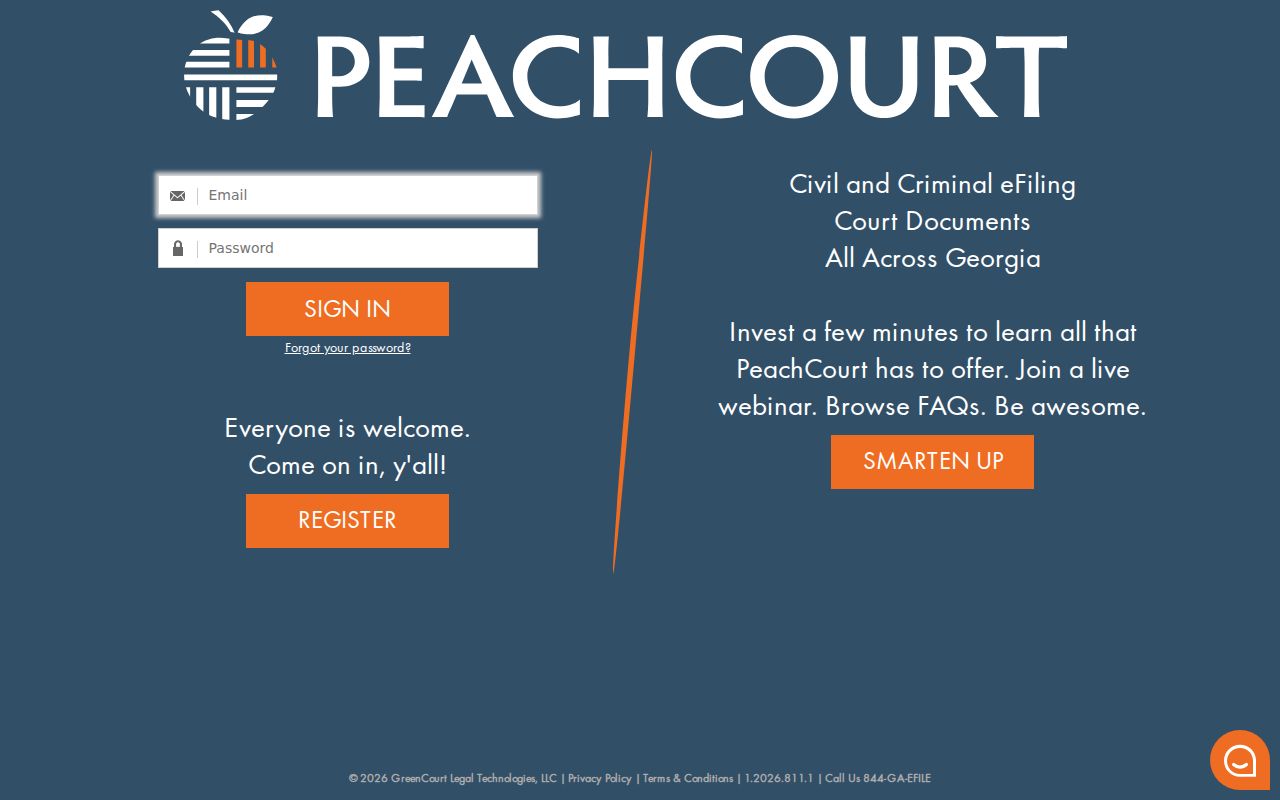
The account screen shows why a provider name alone cannot tell you whether a given Chattahoochee County civil filing is visible. Verify the court, the case type, your account role, and the document charge first. An electronic result only deserves that much trust after the checks.
Chattahoochee County Civil Dispositions
Under Rule 39.2, a disposition is a recorded field with its own date. The local civil record model covers dismissal, settlement, judgment, final divorce decree, administrative termination, and transfer. Each term marks a different legal event. A case vanishing from a public calendar gains none of those labels by disappearing.
Appeal and remittitur cross-references can tie a Superior record to later review. A notice of appeal opens the appellate path. Remittitur hands authority back to the lower court once review ends. To establish the actual result, request the docket entry, the signed judgment or decree, and any matching appeal cross-reference.
- Dismissal
- Closing treatment that may be with or without prejudice; read the order for its actual terms.
- Settlement
- A negotiated civil resolution recorded as a disposition where the court record supplies that entry.
- Final divorce decree
- A final domestic order, distinct from a calendar appearance or a pending petition.
- Remittitur
- An appellate return or mandate that can be cross-referenced in the lower-court record.
Lean on the disposition date and the document itself whenever the result matters. Filing and service entries prove nothing about whether a claim was granted, dismissed, settled, or appealed.
Civil Docket Access Rules
Rule 21 begins with public access to court records, yet privacy rules, protective orders, statutes, and redaction can each narrow what gets released. Rule 21.6 and O.C.G.A. § 9-11-7.1 govern protected personal identifiers along with family-violence or stalking registry information. Domestic, TPO, child-related, adoption, and Juvenile material may face a closer access review than a routine civil entry on the Chattahoochee County docket.
Chattahoochee County Civil Records Contact
Clerk of Superior Court
379 Broad Street
Cusseta, GA 31805
706-989-3424
Mail: P.O. Box 120, Cusseta, GA 31805. Confirm the counter, hours, payment method, copy price, and whether a public inspection option is available.
Access checkpoints:
Uniform Superior Court Rule 21 describes the public baseline and motions or orders that limit access.
Georgia Open Records guidance explains prompt access, descriptions, fee estimates, redaction, and written reasons for withholding records.
The Georgia Attorney General's public-record opinion explains the custodian and response framework under O.C.G.A. § 50-18-70 et seq.
If the online route fails, call the clerk, go to the records counter, or mail a request. The request must name the right court: Superior, Magistrate, Probate, or Juvenile. Include the case number if you have one. Add public party names, a date range, the exact filing or order, your preferred inspection or copy format, and a request for a fee estimate. Ask for the non-exempt portions and the authority behind any redaction. The county offers no confirmed email address, public-record dropbox, copy schedule, or guaranteed turnaround for these requests.
Probate and Magistrate keep separate local contacts for their own record classes. Probate sits at 706-989-3603, and Magistrate at 706-989-3643. Do not send a civil filing to either office just because their Broad Street addresses sit close together.